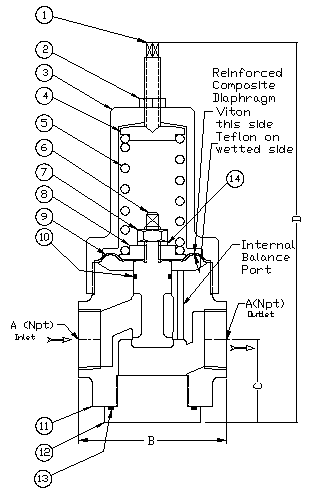
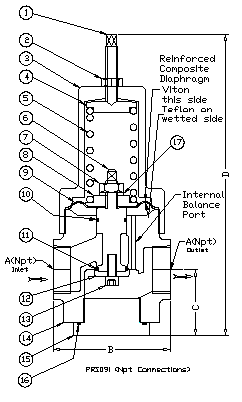
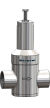
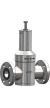
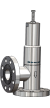
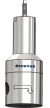
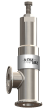
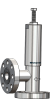
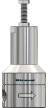
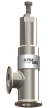
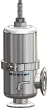
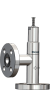
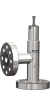
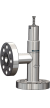
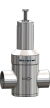
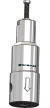
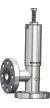
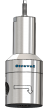
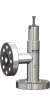
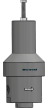
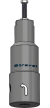
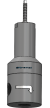
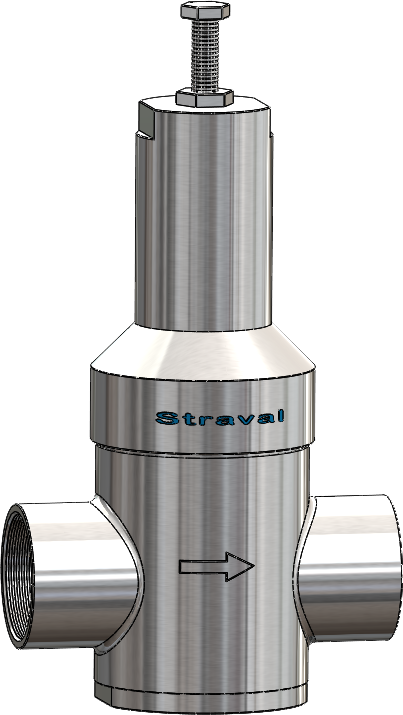
This is a direct-acting diaphragm pressure-reducing valve (most often referred to as a pressure regulator) with an adjustable spring operating against a flexible elastomeric diaphragm subjected to the reduced outlet pressure of the valve which is controlled through an internal sensing port. This makes the valve an accurate pressure-sensing valve, or pressure-control valve used to control outlet pressures with a wide range of inlet pressures.
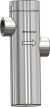
Unlike unbalanced diaphragm pressure-reducing valves, this pressure valve is a balanced inlet design and will work quite well on applications where the inlet pressure will fluctuate widely and will have little effect on outlet pressure. The valve will operate in a vertical orientation as illustrated, horizontal, or any other orientation.
This valve can be used for non-corrosive or mildly corrosive fluids including steam, depending on the materials selected. See material display notes in pricing section to help select materials. Use only clean, strained or filtered fluids to keep the pressure-regulating valve operating at maximum efficiency without clogging. Use our Stra-Val in-line strainer fitting model STF-05 or basket strainers SBS-10 or SBV-05 to keep the fluids clean. Use a #20-#40 mesh range as a minimum to keep solids from entering the valve.
Applications are for use as a water pressure-reducing valve, water pressure regulator, steam pressure regulator, air pressure regulator, oil pressure regulator. Most applications are sold where a corrosion-resistant valve is preferred, where we manufacture these mostly as a stainless steel valve for the wetted components, using type 303 stainless steel or type 316 stainless steel for chemicals or when a sanitary valve is required with sanitary flanges. For seawater applications the Monel valve, titanium valve, or Hastelloy valve is used. Although Inlet pressures of up to 220 psi (15 bar) are possible, we do not recommend it unless the largest spring range is selected and there is a relief valve that is set not to exceed 100 psig (6.9 barg) on the outlet side of the valve. This relief valve will assure that the downstream pressure will never reach full inlet pressure in case the regulator fails to shut off properly for any reason. In fact we always recommend a relief valve be installed on the outlet side of the valve which should be set slightly higher than the highest pressure that the regulator will be adjusted to to protect equipment downstream from the regulator in case of excessive pressure buildup which may be from seat wear, corrosion, or external sources other than the valve.
The standard construction for this pressure-reducing valve is with a metal seat, but a soft seat option can be ordered, which will improve seat leakage particularly for air or gases.Therefore, do not attempt to use this as a shutoff valve even when the valve is furnished with a soft seat option. For prolonged or even momentary periods of shutoff, install separate shutoff or isolation valves to keep the relief valve from tripping.
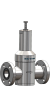
This in-line pressure regulator has fairly adequate Cv values for most applications. See below. For higher flow rates and larger Cv values, a custom pressure valve model PRS-09 with the porting arrangement parallel and slightly offset which requires additional elbows to restore in-line piping.
We now offer some models that meet NACE MR0175. These are not priced on line. Consult factory.
Select the valve size, spring range, material options in the customized pricing and ordering section indicated by the red arrows. You have the ability to customize your valve choices by selecting the wetted and nonwetted materials, and choice of seat materials to suit your shutoff requirements, using the softer seats for improved shutoff, particularly for air or gas applications. Once these selections are made a price quote can be generated and printed directly to your computer or immediately e-mailed to you.
The valve operates on the principle of balancing the spring force that is set by the user against the outlet pressure acting under the diaphragm. There is an internal pressure balancing port that subjects the outlet pressure directly to the underside of the diaphragm. When the outlet pressure falls below the set pressure required by the system on the outlet side of the valve, the spring force overcomes the force balance under the diaphragm causing the poppet and diaphragm assembly to drop down causing the valve to open and allow higher pressure at the valve inlet to pass through the valve. When the pressure rises to a sufficient level to restore the force balance against the spring, the valve will move toward the closed position. The valve is completely self regulating and the poppet is constantly moving to respond to pressure changes on the outlet side of the valve, not the inlet. The only time the poppet closes completely is when the outlet pressure has been reached to its set point. As long as the valve is able to shut off properly without solids or other material build up in the seat or because of seat wear, the valve should be able to maintain and hold the outlet pressure and keep it from rising for brief periods of time. If the valve is set with no flow passing through the system, there will be some droop (drop in outlet pressure) caused by relaxation of the spring when the valve first has to open. This occurs with all direct spring operated valves and can be compensated by making a slight readjustment to the set pressure once the desired capacity has been achieved.
 What's NEW














 view prices